Maghi Purnima: A festival of ritual, inner purification
In the Hindu religious and philosophical tradition, Maghi Purnima is a date of profound significance.
Pret is a Hindi adaptation of Henrik Ibsen’s landmark 1881 play Ghosts, translated by noted scholar and playwright Nemi Chandra Jain.




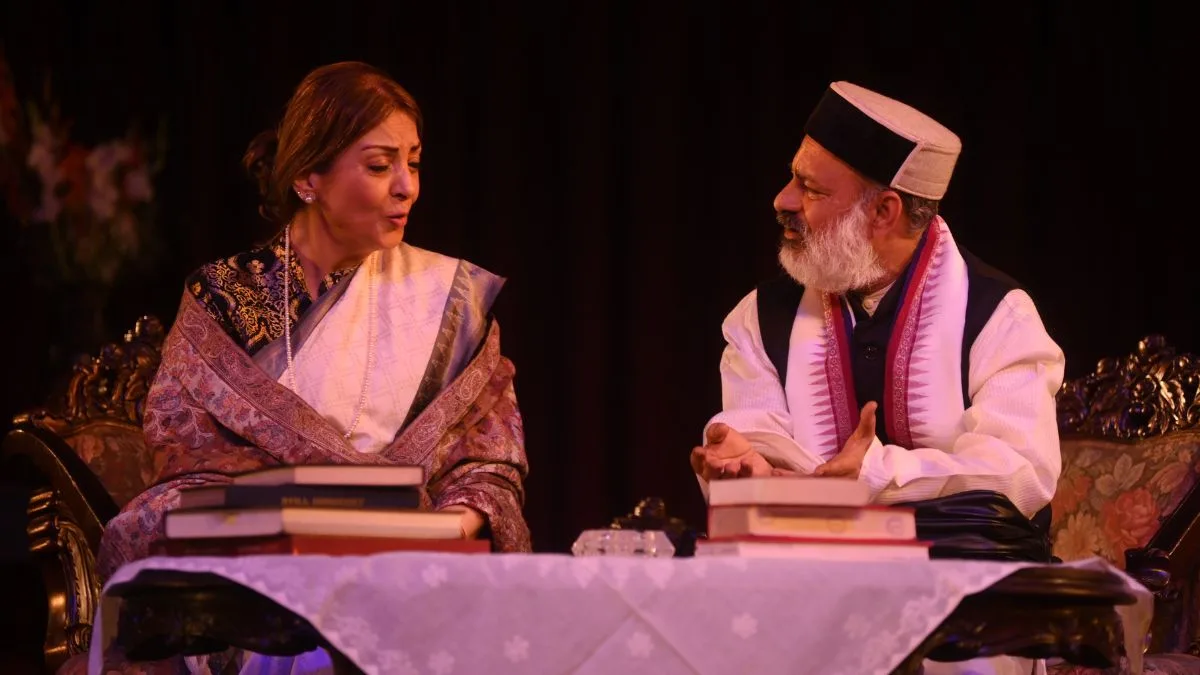
PRET
At a time when societies across the world are grappling with the friction between tradition and change, theatre veteran M K Raina’s latest production “Pret” arrives as a disturbing and deeply relevant intervention.
Pret is a Hindi adaptation of Henrik Ibsen’s landmark 1881 play Ghosts, translated by noted scholar and playwright Nemi Chandra Jain.
Advertisement
For Raina, revisiting Ghosts is not an act of nostalgia but of urgency. “Contemporary,” he explains, “is the confrontation between new ideas, new discoveries and new beliefs against old beliefs.”
Advertisement
Written at a time when Europe was being intellectually shaken by Darwin’s Origin of Species, Freud’s emerging psychology and Marx’s Communist Manifesto, Ibsen’s play questioned inherited morality, social hypocrisy, and the cost of silencing truth.
Those tensions, Raina believes, are far from resolved. In Pret, these conflicts are translated seamlessly into an Indian context, where the struggle between scientific rationality and rigid social codes continues to shape personal and political life.
The central conflict mirrors Ibsen’s original: a society desperate to protect its moral image even if it means perpetuating lies that destroy future generations. The “ghosts” here are not supernatural beings, but inherited ideas of fear, repression, blind faith, and the anxiety of “what will society say?”
The title Pret, a word laden with moral, psychological and spiritual meaning in Indian culture, was chosen deliberately.
For Raina, the “Pret” is internal. “Everyone has a ghost within themselves,” he says, reflecting on his own experiences of fear, rebellion and self-realisation. These ghosts surface during moments of transition: between generations, ideologies, and ways of seeing the world. India, he notes, is currently “stuck” in such a confrontation, negotiating the pull of the past against the demands of the present.
The play also draws from older theatrical traditions. The idea of sin repeating itself across generations, with innocent children becoming victims of inherited guilt, has roots in Greek tragedy.
In Pret, disease becomes a powerful metaphor not merely a medical condition like syphilis, which haunted Ibsen’s time, but a symbol of a diseased society. “He is not dying,” Raina explains of the afflicted character, “he is being devoured.” The illness represents a community that consumes its own by refusing to confront the truth.
This metaphor resonates strongly in contemporary India, particularly in the context of women and silence.
Asked whether Indian women are still expected to protect family honour at the cost of truth, Raina acknowledges that while change has begun, the struggle continues.
“What my mother did, what my sister does, what my daughter will do in each era is different,” he says.
Progress, for him, is not a single rupture but a continuous movement across generations, often propelled by women who push against boundaries imposed on them.
The production features a distinguished cast including Rakesh Kumar Singh, Kavita Seth, Vipin Kumar, Namrata Sinha and Arpit Anand, who bring emotional depth and intensity to this layered adaptation. The play is produced by Anuradha Dar, a prominent figure in Delhi’s theatre and education circles. Dar describes Pret as “not just a play from the past, but a mirror held up to our present.”
She emphasises theatre’s role in provoking thought and unsettling comfort.
“Our endeavour at TAC has always been to bring meaningful, intellectually engaging work to audiences,” she says, “and Pret continues that legacy.”
Ultimately, Pret does not offer easy answers. Instead, it leaves audiences with a wide range of questions. What is the real disease afflicting us? Is it moral hypocrisy, blind faith, or the refusal to investigate and accept truth?
Advertisement